Dmytro Shevchuk, call sign SHEVA
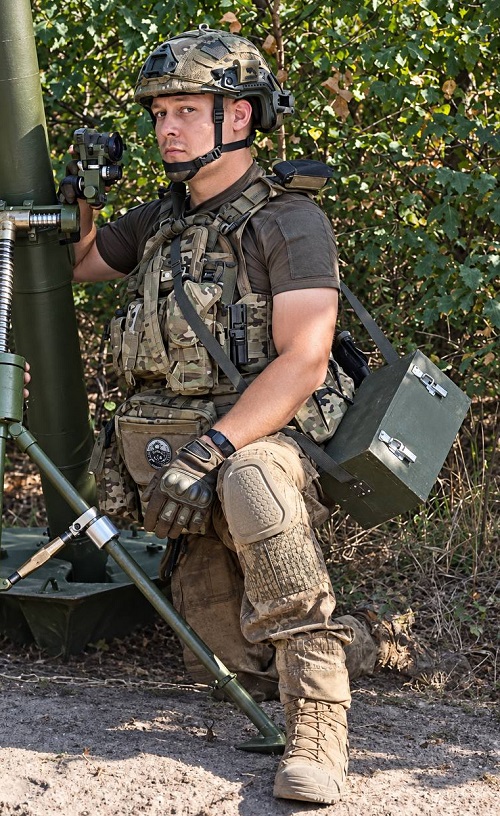
Greetings, dear ladies and gentlemen. My name is Dmytro Shevchuk, call sign SHEVA. I am from the fortress city of Kharkiv. I am a veteran of the war with Russia and, unfortunately, have already been discharged from the military. In recent years I have been fighting the consequences of a severe wound that I sustained in battle with the occupiers. And today I need specialized rehabilitation at the "Markiv Rehab" medical center. But first I want to tell how I ended up at this point.
At the start of the full-scale invasion I was living in Kharkiv and working as a programmer. At that time it was difficult to find a place in the military in our city, so I voluntarily joined the 127th TDF Brigade, which began forming at the beginning of March 2022. In the first year of the war I fought first in the infantry and later as a gunner in a mortar battery. I participated in combat operations in Kharkiv and the oblast, and fought near Bakhmut.
Later I managed to transfer to the Airborne Assault Forces — to the 78th Separate Airborne Assault Regiment "Herts," which was being formed from volunteers. As before, every decision I made in those times was directed toward one goal — to fight as effectively as possible among professionals, inflicting maximum damage on the enemy's manpower and equipment. That is why I once chose artillery and mortars as some of the most lethal means of destruction. During the unit's working up, I underwent additional specialized training at a training center.
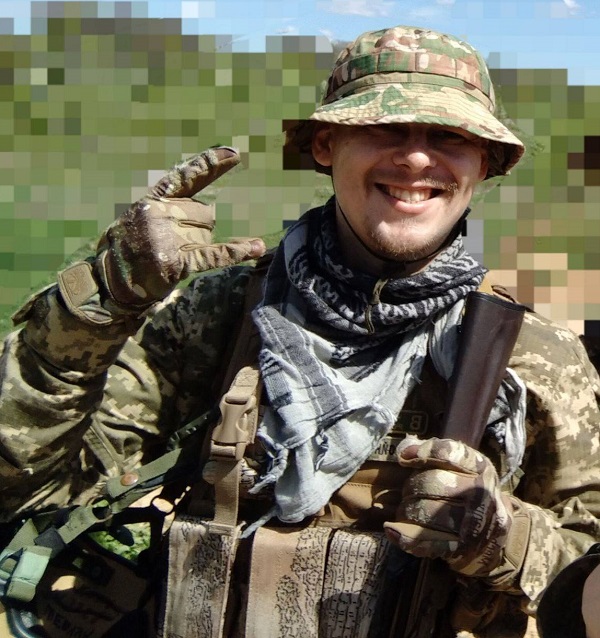
At that time we planned to replace the units of the 47th Brigade "Mahura" in assault operations in the Zaporizhzhia direction. After working up and completion of formation, as part of one of the line assault battalions of the "Herts" regiment, I ended up in one of the hottest directions at that time — Robotyne. It was there that I worked with a 105mm M101 howitzer, made in the USA back in the 1940s, which had already fought against the Nazis during the Second World War.
For me this is a very symbolic fact. A weapon that had traveled through time, passed through the hands of warriors of several armies of the world, continued the fight against a new world evil, helping us contain the Russian onslaught. During combat duty shifts at the firing position near Mala Tokmachka, we conducted artillery duels with the enemy, stopped constant assaults on our fellow soldiers' positions with fire, and supported our own assaults.
It was there, at the end of October 2023, that I was wounded. It was night, and I was on duty with a radio in anticipation of combat work. I heard the outgoing fire of enemy artillery and from how much closer the shells began to land to my individual bunker, I sensed that they were targeting our crew specifically. I lay down along one of the walls. As it turned out, this was the best decision I could have made at that moment.
A second — and it seemed to me that I had fallen asleep. Darkness alternated with dreams, memories, and unclear images. And somewhere at the periphery of consciousness a thought kept circling: "Fool, you fell asleep on duty in combat!" I regained consciousness already in the hospital in Zaporizhzhia. Almost no memories of the evacuation and the stabilization point remained.
Later, the fellow soldiers who saved me told me that a 122mm shell had struck my bunker. I was saved by the overhead cover and the armor I was wearing. I was buried, and the guys from my crew dug me out and in the darkness carried me to the edge of a tree plantation. There our MPZ officer already picked me up in one of the Humvees. My fellow soldiers told me that I was responsive and able to talk, although I did not recognize anyone and did not even understand that I had been wounded. I remember almost nothing of the evacuation or the stabilization point.
In Zaporizhzhia I was stabilized and sent to the Mechnykova Hospital in Dnipro. There I came to my senses more or less, underwent the first several surgeries, and saw my family, who had come to support me.
As for the wound itself: fragments shattered the humerus and radius of my left arm, partially crushed the elbow, tore out a great deal of muscle, severed the thumb, and crushed the bones of the palm. On the left leg, most of the quadriceps was torn out, and there was a closed fracture of the ankle. On the right arm, part of the middle finger was severed. The skull bones were fractured, and I sustained a second-degree traumatic brain injury. Burns and fragments covered my entire body. I also sustained extensive damage to the nervous and lymphatic systems in the left limbs. The armor and helmet were among the factors that saved my life.
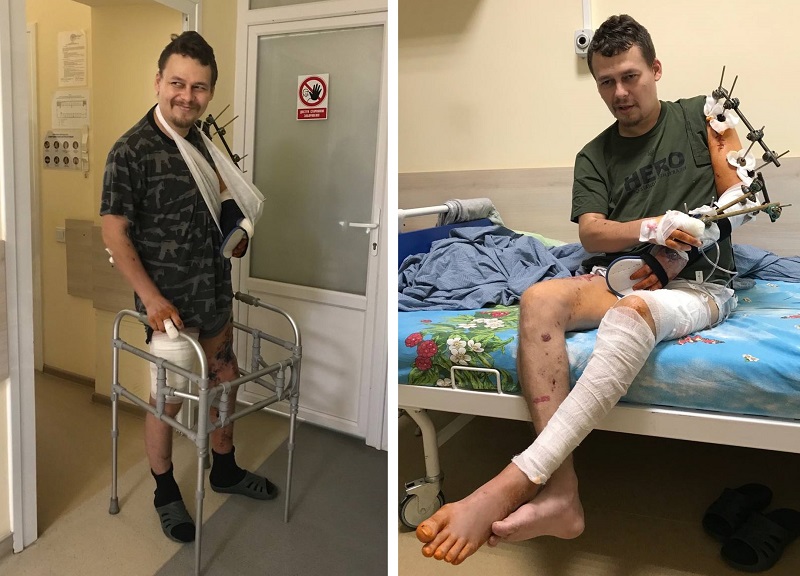
The treatment was difficult and lasted almost a year. After Dnipro I ended up at the Military Medical Clinical Center of the Central Region in Vinnytsia — there I was put back together and nursed back to health. I underwent 19 surgeries on my leg and arms, after which I was transferred to the 77th Rehabilitation Hospital. There I was taught to walk again, my basic adaptation and self-care skills were restored, and several more surgeries were performed.
Next I ended up in the rehabilitation department of the Yushchenko Hospital, where civilian specialists in physical and rehabilitation medicine, physical therapists, and occupational therapists worked with me. The next stage was the Pyrohov Hospital, where the bones of my arm were fixed with plates — without this the bones in the crushed arm simply refused to heal. And then came another four to five months of rehabilitation at the 77th Hospital and the Yushchenko Hospital.
This was a difficult and painful path of recovery. Psychological "swings," constant work on oneself, and at the same time a great many wonderful people by my side who helped me not lose my mind, relearn how to walk, and adapt to a new life. But after a year of treatment and discharge, I was released from the ranks of the Armed Forces of Ukraine due to my health condition. I became a civilian — but not of my own will.
After a bureaucratic ordeal I received a Group II disability for two years. That is how I ended up in that strange suspended state — of constantly fighting my wounds while at the same time feeling guilty toward my fellow soldiers, whom I was forced to leave due to my disability.
But I do not give up. The enemies will not live to see that day.
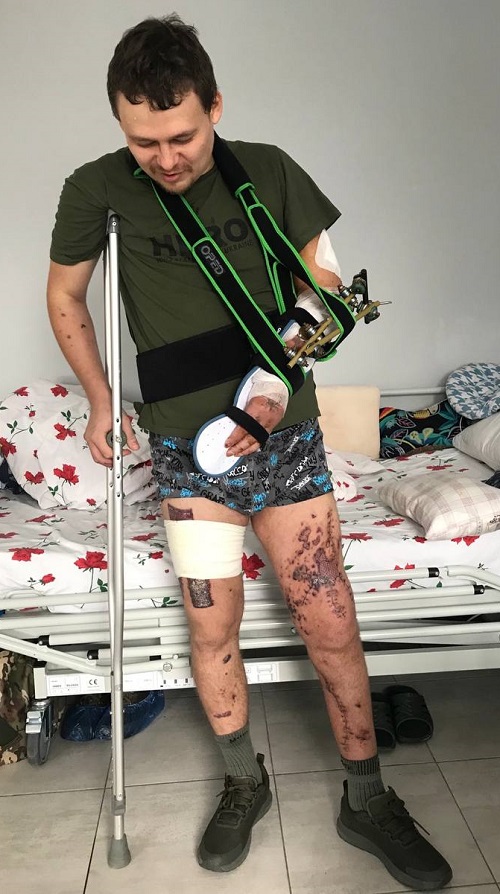
In recent years I have been constantly engaged in rehabilitation and adaptation — both independently and with the help of rehabilitation specialists. Due to the disability, finding work is almost impossible, so right now I live on a temporary pension and small additional earnings. My old job as a programmer is no longer as relevant due to the boom in neural networks. In parallel I do volunteer work for my fellow soldiers and print useful and interesting items for "Druk Armii."
The most important thing for me right now is to continue the fight. The minimum task is to adapt to civilian life, master a new profession, and learn to live without war. But there is also a maximum task — I want to prepare to return to my fellow soldiers, in order to once again have the opportunity to defend my country, my culture, my language, and my way of life. And for this I need to learn to run again, jump, balance, squat, and maximally restore the functionality of my left arm.
Recently I found the "Markiv Rehab" rehabilitation center. And for me this became a new hope. After the consultation I understood: a great deal of work has already been done. I can take care of myself, walk, and do basic things. But most importantly — I still have capabilities that, with the help of specialists and modern approaches, one can try to realize.
I heard things that were very important to me: my left arm is capable of more, and the current situation is not a verdict, but merely the next stage of recovery. The leg is capable of compensating for the absence of part of the muscles, and I can work toward running again. For me this is not simply physical rehabilitation. This is a chance to reclaim yet another portion of that life and those possibilities that were taken from me by that 122mm shell.
I see in "Markiv Rehab" a new approach that is not always available in state clinics. But my own resources are not sufficient to undergo the necessary specialized rehabilitation. That is why today I am compelled to ask for help.
I have already been through a severe wound, dozens of surgeries, almost a year of treatment, months of rehabilitation, and the necessity of relearning how to walk and adapt to my own body. I do not know how far I will be able to go in my recovery. But I know for certain that I want to use every opportunity that my body, medicine, and people ready to help can give me.
I sincerely value the help and support. For my part I am doing everything that depends on me to continue recovery. Because my fight is not yet over.
With respect and gratitude,
Dmytro SHEVA Shevchuk, the fortress city of Kharkiv
COLLECTING: UAH 52,300