Oleksandr Honcharov, call sign HONCHAR
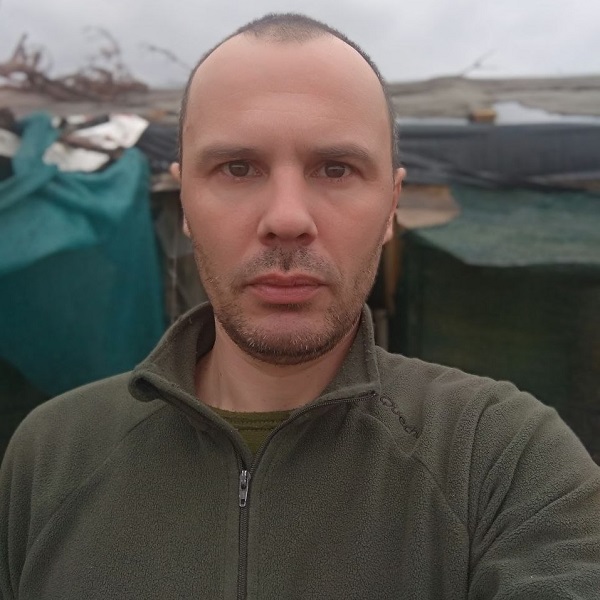
I began my service in July 2022 in the ranks of the 104th TDF Brigade. Before that I had practically no military experience, not counting my conscript service in 2005–2006.
At first our unit was stationed on the border with the Republic of Belarus — we ensured the defense in case of a possible attack. But the time came when we were sent to the East. We were near Chasiv Yar. There we gained our first combat experience and, unfortunately, suffered our first losses of fellow soldiers. Later we were transferred to Kherson Oblast. Our company carried out missions in the area of Krynky and the adjacent islands. That was probably the most difficult period. We were separated from our own by just some 700 meters. But those 700 meters were the waters of the Dnipro.
During my service I traveled the path from senior soldier-driver to junior sergeant, squad commander.
After Kherson Oblast we moved to Kharkiv Oblast, to the Kupyansk direction, where we participated in restraining the enemy’s active offensive operations. That is where I was wounded.
On August 31, 2024, at approximately 17:00, our group of fellow soldiers came under fire from a 120mm mortar. We took cover in a tree plantation. The first strike concussed and slightly cut with shrapnel almost everyone. But there was no time to assess the damage. Before we could recover, we were hit again.
I did not hear the second strike.
I felt a terrible blow and plunged into darkness. As if I had died. All sensations switched off. From that darkness I was pulled by severe pain. But the understanding of who I was and what had happened was not yet there. From the pain and incomprehension I cried out. My own cry I more felt than heard.
And then I came to my senses. I understood that I was alive.
I began to assess the damage. I immediately felt that my left arm was not responding at all. With my tongue I felt torn lips and knocked-out teeth. And also I could see nothing. Hearing began to return first. The senior soldier was calling out to everyone, asking who was in what condition. He asked me where my radio was. I did not know where it had gone and could not help him. Then the guys found its fragments.
Vision began to return. Tears slightly washed my eyes of earth and other debris. Through the haze I saw my left arm and understood that a tourniquet needed to be applied. I could not do it myself. My right arm, although it responded, was also wounded and weak. I asked for someone to help. My fellow soldier Yura crawled to me. Of the two tourniquets on my body armor, the left one had been torn by the explosion. But the second one was intact and everything worked out.
The senior soldier found his radio, and I heard him reporting what had happened, requesting evacuation, and saying that we had two “200s”…
Thanks to the electronic warfare unit that covered us from drones, the commanders who planned the evacuation, and above all those daredevils who rushed in on an ordinary pickup truck, all of us — both the living and the dead — were evacuated.
Already at 19:50 the wounded were unloaded at the stabilization point. There I received the necessary assistance. When I understood that I was safe, I even tried to joke. But the medics were too busy with my injuries to understand my jokes and respond to them.
After stabilization I was immediately taken to Kharkiv. I arrived there late at night. After CT and X-ray, a great number of fragments were found in the face, around and in the eyes, in the neck, and in the upper part of the torso. There were complex fractures of the bones of the left forearm in several places and significant soft tissue damage to both arms.
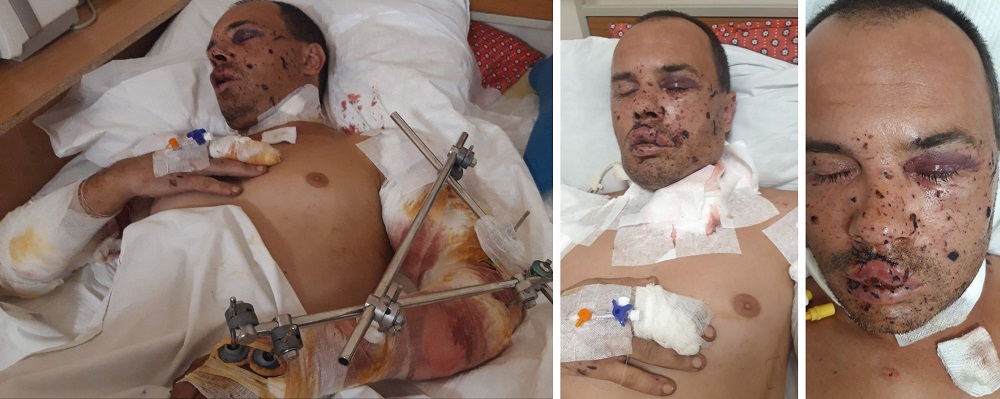
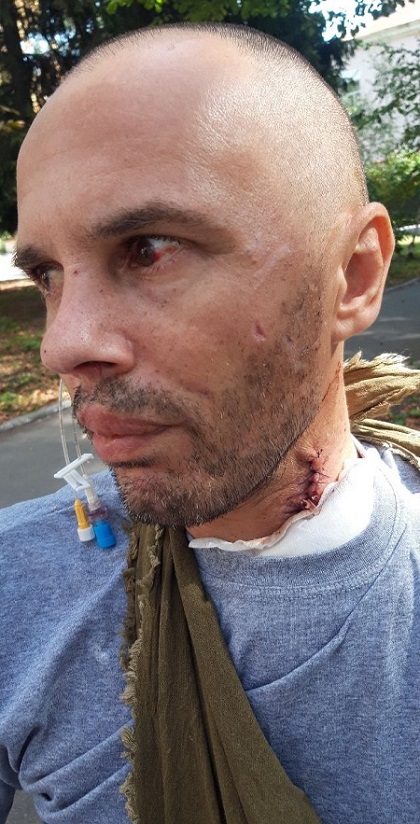
Surgeries began immediately. Ophthalmologists sutured the membrane of the right eye. Trauma orthopedists assembled the bone fragments of the left arm and fixed them with an external fixation device. Vascular surgeons removed the largest fragments from the neck and a fragment from under the collarbone, which had lodged in the first rib, fracturing it.
Later a rupture of the left eardrum was also discovered.
On the fourth day I was evacuated to Kyiv. There were no longer any prospects for saving the vision of the right eye, so the doctors focused on saving the left arm. In Kyiv I spent almost a month and during that time underwent seven surgeries: excision of necrotic tissue, skin grafting on the large affected areas, and suturing of the cleaned wounds.
Then came Ivano-Frankivsk. Almost another month. Dressing changes, suture removal. And there were many sutures.
At the end of October I arrived in Rivne. Surgery was planned to dismantle the external fixation device and assemble the bones that had not healed together using plates. But at that time my right eye began to cause serious concern. I had to return to Kyiv again. There another surgery was performed. A fragment and a great deal of debris were removed from the eye, and silicone was injected in place of the extracted tissue. The eye was saved from removal. But the return of vision was no longer being discussed — the structure of the eye and the retina were too severely damaged.
At the beginning of December I returned to Rivne. At the end of the month I underwent two more surgeries. First the external fixation device was dismantled. Then the bones that had not healed were assembled and fixed with internal plates.
That was how my path of recovery began.
From February 2025 I underwent rehabilitation at various facilities in Rivne Oblast. I was optimistic and believed that the arm would recover. Unfortunately, I did not immediately end up in a specialized rehabilitation department. For a long time I was treated in the neurology department in Klevan, attending light physiotherapy and massage. Later an ENMG and ultrasound were performed and damage to the ulnar and radial nerves was discovered. The eardrum of the left ear meanwhile healed on its own.
At the end of May I arrived at the Recovery rehabilitation center in Rivne. I worked extensively with an occupational therapist, because I wanted to restore the functions of the arm to the maximum extent. Thanks to the specialists of the center, a great deal was achieved. The arm became stronger. New movements appeared.
I also hoped that thanks to Recovery’s cooperation with the Institute of Neurosurgery, surgery to restore the damaged nerves would be performed on me. But due to the age of the wound and the risk of losing the functions that had been preserved as a result of the intervention, I was refused the surgery.
So the hope remained with rehabilitation and work with the occupational therapist.
In August 2025, alongside sessions at Recovery, I began attending a private rehabilitation center Restore Life under a veteran recovery program. I worked there until the end of the year. The double workload helped. Noticeable progress occurred. I began lifting twice the weight, mobility improved, and I was able to perform new actions with the arm.
A year had passed since the wounding. After treatment I had to undergo a Military Medical Commission examination for fitness for service. The process dragged on, but ultimately I was found unfit. In November 2025, on the basis of the Military Medical Commission’s conclusion, I was discharged.
In December I underwent the EKOPFO procedure and received a Group II disability for life.
From the new year, due to personal circumstances, I did not undergo rehabilitation. To the extent possible I occupied myself with household matters. After Recovery and Restore Life the arm for some time continued to show progress by momentum. Endurance and strength grew, contractures eased, and pain sensations decreased.
But eventually this progress stopped.
However, I know that the recovery potential of my arm is far from exhausted.
I want to recover to the maximum possible level. Doctors strongly advise undergoing rehabilitation at specialized facilities at least once a year in order to maintain and continue progress.
Today my arm does not bend and extend fully at the elbow. Supination and pronation — movements of the forearm that allow turning the palm upward and downward — are practically absent. The wrist extensor muscles are very weak, so under load the wrist bends inward. Due to finger contracture the grip remains incomplete.
But I already know that rehabilitation works.
I saw how the arm grew stronger. How movements appeared that had not been there before. How something that did not work yesterday suddenly began to work one day. That is why I do not want to stop at what I have now.
In order to rise to a new level in recovery, I need an intensive specialized rehabilitation course at the “Western Rehabilitation and Sports Center” of the NCSPI.
The rehabilitation is paid for. That is why today I am compelled to ask for help.
I know for certain: the potential of the arm is not yet exhausted. And while there is a chance to regain a little more strength, one more movement, one more portion of function I want to fight for it.
____________________________________________
The fundraiser for the rehabilitation of seriously wounded defender Oleksandr Honcharov has been successfully closed. Thanks to your support, the need was fully covered, and Oleksandr has already completed the specialized rehabilitation course.
And most importantly — there is a result.
During the course it was possible to increase the strength and range of motion in the injured arm, and to improve overall physical fitness and endurance. If at the beginning Oleksandr could not perform a single dip on the parallel bars — by the end he was able to do 3. The number of pull-ups increased from 1 to 4. Forearm supination increased from 25° to 40°, wrist flexion — from 50° to 70°, and extension — from 20° to 60°.
These are not simply numbers. These are movements and capabilities that are gradually returning.
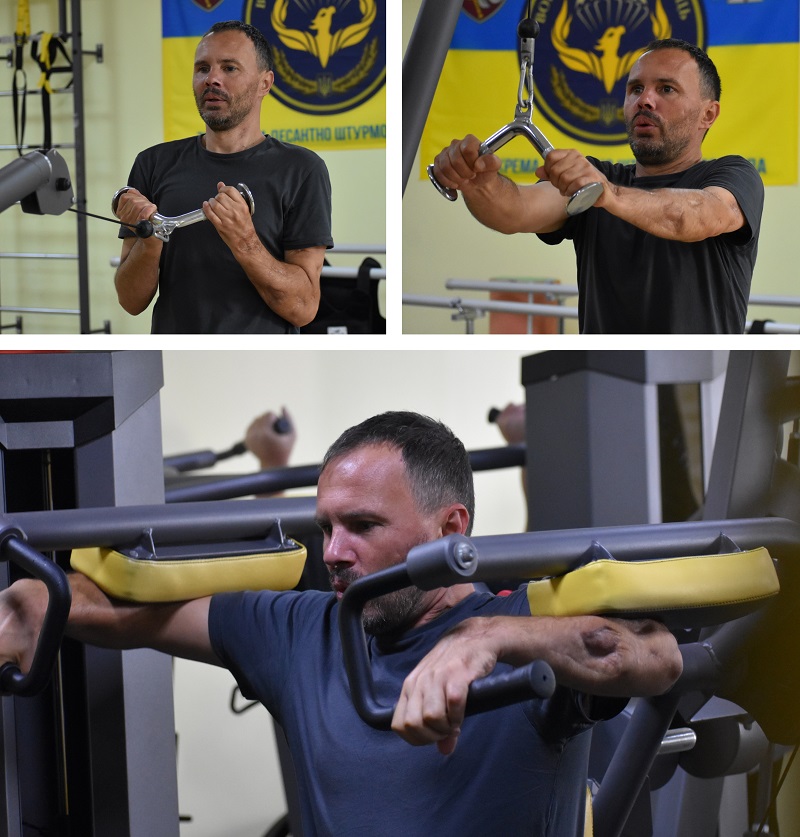
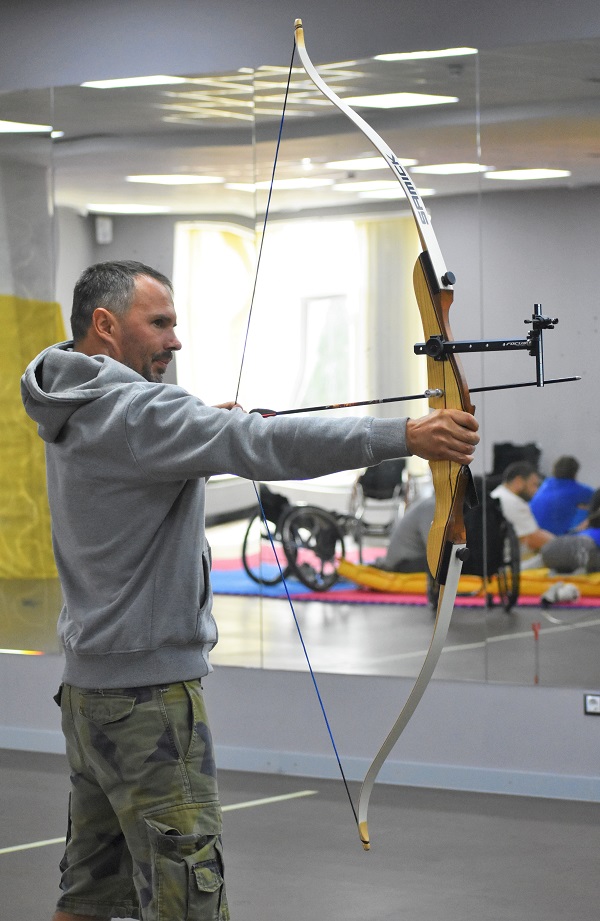
We sincerely thank everyone who joined the fundraiser: with a donation, a share, a kind word, and support. It is from such small and large contributions that this result was built.
Special great gratitude to the team of rehabilitation specialists for their professional work, perseverance, and the results achieved together with Oleksandr.
Rehabilitation does not end here. Contracture and reduced strength of the left hand persist, so recovery needs to continue. But today we can already see: the arm can do more. And this gives faith that ahead — there will be more as well.
Thank you for helping to walk this difficult path of recovery!
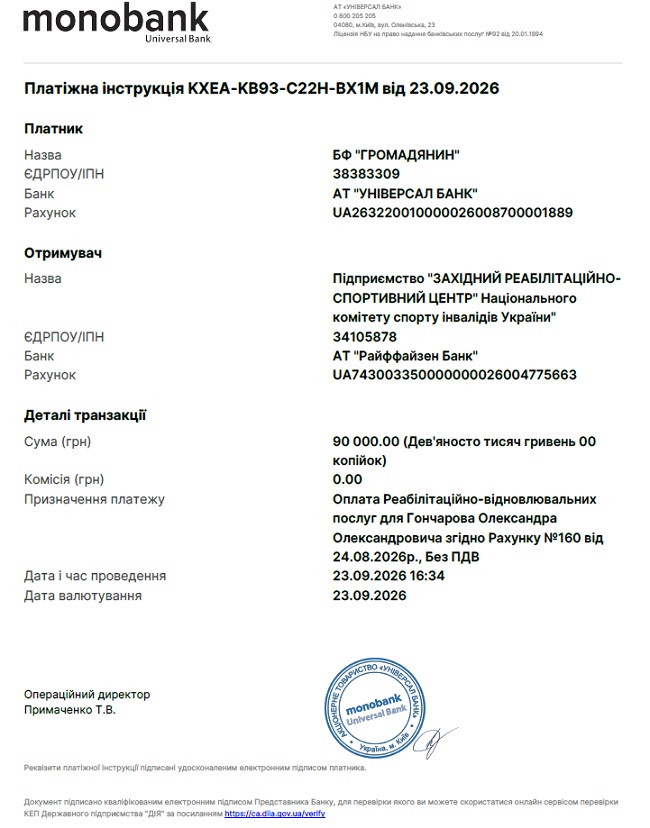
COLLECTED AND TRANSFERRED: UAH 90,000